
Defibrilators: How a 14-Year-Old Boy’s Life Sparked a Revolution in Emergency Medicine
Imagine being on the operating table, your heart suddenly stopping mid-surgery. In 1947, that terrifying scenario became a historic turning point—because that’s when a Cleveland heart surgeon named Dr. Claude Beck did something unprecedented: he brought a clinically dead boy back to life with electricity.
Using a bulky, experimental machine and a chest already cut open, Beck delivered a jolt that restarted the boy’s heart. It was the first successful human defibrillation, and though it only worked in an operating room under special conditions, it opened the door to something much bigger.
Fast forward a decade, and Dr. William Kouwenhoven—along with his team at Johns Hopkins—changed the game. In 1957, they introduced a defibrillator that didn’t require cracking the chest open. Designed initially to revive workers electrocuted on the job, their closed-chest defibrillator marked a massive leap in bringing heart-restoring technology out of the OR and closer to the public.
But the story doesn’t stop there.
In the 1960s, across the Atlantic in Belfast, Northern Ireland, a visionary named Dr. Frank Pantridge looked at this life-saving tool and asked: Why isn’t this in ambulances? So he built one that was. His creation—a portable defibrillator—was a groundbreaking development in pre-hospital care. Now, lives could be saved before patients ever reached the ER. Pantridge’s invention laid the groundwork for the Automated External Defibrillators (AEDs) we see in airports, gyms, schools, and city streets today.
The science behind this miracle didn’t start in the operating room, though. Back in the late 1800s, two physiologists—Jean-Louis Prevost and Frederic Batelli—discovered that electric shocks could reverse deadly heart rhythms in animals. Their early work, largely forgotten by the public, planted the first seeds of modern defibrillation.
Today, AEDs are compact, smart, and user-friendly. They talk you through the process. They save countless lives. But they exist only because generations of scientists, doctors, and engineers believed in the power of electricity to restart the human heart.
What began with a desperate shock in a Cleveland operating room is now a global tool for survival. And every time someone uses an AED in an emergency, they’re continuing a legacy that spans more than a century—a legacy born from hope, hard science, and the refusal to let death have the final word.
The Microchip: The Tiny Invention That Changed the World
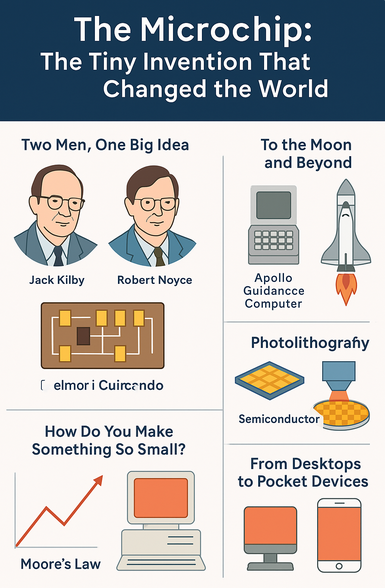
It’s hard to imagine a world without smartphones, laptops, or even microwave ovens. Yet all of these marvels—and countless more—owe their existence to one tiny invention: the microchip (integrated circuit).You might never see one, but chances are there are dozens of them within arm’s reach right now. Microchips are the invisible engines of modern life, quietly powering everything from your car’s GPS to the smartwatch on your wrist.
But how did we get here?
Two Men, One Big Idea
The microchip was born in a time when computers filled entire rooms and had less brainpower than a modern calculator. In 1958, an engineer named Jack Kilby, working alone at Texas Instruments, made history. He figured out how to squeeze all the components of a bulky electronic circuit onto a single piece of semiconductor material. A few months later, Robert Noyce, who would go on to co-found Intel, built a similar chip—only his used silicon, which proved more practical.
To the Moon and Beyond
In the early days, microchips weren’t in your home—they were in outer space. Their small size and reliability made them perfect for the high-stakes world of NASA’s Apollo missions. In fact, they helped guide astronauts to the Moon in 1969 with the Apollo Guidance Computer—one of the earliest real-world applications of integrated circuits.
Once proven in space, microchips came down to Earth. Soon, they were popping up in calculators, hearing aids, and—by the 1970s—in the first personal computers.
How Do You Make Something So Small?
At the heart of every microchip are tiny electronic switches called transistors. Back in the 1950s, these were bulky things made by hand. That changed thanks to Jay Lathrop, who had a radical idea: what if you could use light to etch microscopic patterns onto semiconductor material?
He invented photolithography—a process that uses light and chemical reactions to etch tiny patterns into silicon wafers. Lathrop flipped a microscope lens to shrink those patterns, allowing chips to become far more complex and compact.
Today, advanced lithography allows chipmakers to etch circuits only a few nanometers wide—smaller than a virus—into silicon, enabling the mass production of processors with billions of transistors.
Moore’s Law: The Rule That Changed Everything
In 1965, Intel co-founder Gordon Moore noticed something fascinating: the number of transistors on a chip was doubling roughly every two years. This trend, known as Moore’s Law, held true for decades—and drove an explosion in computing power. It’s the reason your smartphone today is more powerful than the computers used to send astronauts to the Moon.
The Chip That Became a Brain
By the 1970s, the first microprocessors arrived—chips that could think. The Intel 4004, released in 1971, was the first of its kind. Suddenly, computers didn’t need to be built from dozens of parts. A single chip could do the job of thousands.
At the same time, memory chips were developed to store data—RAM, ROM, flash storage. These chips were like the short-term and long-term memory of a computer, holding everything from operating instructions to your latest selfie.
From Desktops to Pocket Devices
When the IBM PC hit the market in 1981, microchips brought computing into homes and offices around the world. But that was just the beginning. As chips got smaller and more powerful, they gave rise to something truly revolutionary: the smartphone.
Today’s phones are millions of times more powerful than the early computers. They’re packed with specialized chips for graphics, sound, security, and even artificial intelligence.
Speaking of AI—modern AI systems rely on powerful chips called GPUs. These chips process massive amounts of data in parallel, making it possible for machines to learn, recognize faces, or generate human-like text. Without microchips, none of this would exist.
One Tiny Chip, Infinite Possibilities
It’s easy to take microchips for granted. But every time you stream a video, ask a smart speaker a question, or tap a credit card, you’re using a piece of technology that was once just a wild idea in a dusty lab.
From moon landings to machine learning, from radios to reality-bending virtual worlds—the microchip made it all possible. And the story’s not over. As chips get smaller, faster, and smarter, they’re taking us into a future that’s only just beginning.
The Accidental Revolution: How a Gut Hormone Became a Global Health Hero
Once upon a time in the world of medical science, weight loss drugs had a reputation about as appealing as soggy kale. For decades, they either didn’t work, didn’t work well, or had sidehat made people wonder if extra pounds were really that bad. Then along came a surprising hero: a little hormone produced in your gut after you eat. It was called GLP-1
But our story started in 1906 when scientists discovered that some mysterious stuff in the intestines could lower blood sugar. That’s where the trail went cold for half a century. Then, in the 1960s, a curious clue popped up: when people drank glucose instead of getting it through an IV, their insulin response shot up—a phenomenon known as the incretin effect.
Scientists knew it existed but didn’t know what it was.
Now fast-forward to the 1980s. Svetlana Mojsov, a biochemist with a knack for building complex peptides, was working with glucagon, a hormone that helps prevent low blood sugar. At the same time, Joel Habener, an endocrinologist from Massachusetts General Hospital, was studying this hormone in deep-sea anglerfish (yes, the ones with terrifying teeth and little lanterns on their heads). While digging through its genetic code, he found something strange: nestled next to glucagon was a mystery peptide. Then it showed up again in hamster genes. They called it GLP-1—short for Glucagon-Like Peptide-1. Mojsov synthesized it—31 amino acids long—and tested it with Habener. The result? A jaw-dropping surge in insulin the a eureka moment that changed everything.
But GLP-1 had a fatal flaw: it vanished from the body within minutes. It was like trying to heat your house with a sparkler—bright, but way too brief.: Lotte Bjerre Knudsen, a chemist from Novo Nordisk spent years—tweaking, modifying, and testing thousands of versions of GLP-1 until they finally struck gold: semagltide This modified version clung to proteins in the blood long enough to stay active for a whole week. It was FDA-approved in 2017 to treat diabetes. But the real surprise came when they cranked up the dose: people began losing weight. Lots of it.
We’re talking 15% of body weight—over 30 pounds in someone weighing 220. And not from a crash diet, but from a once-a-week shot. In 2021, semaglutide was approved as a weight-loss medication. But it wasn’t just helping people fit into their jeans—it was slashing the risks of heart attacks, kidney failure, and even some cancers.
Millions of people began taking them. Social media exploded with success stories. Doctors had a powerful new tool, and for many who had struggled for years, hope finally had a name.
And the revolution isn’t over. Next-gen drugs like tirzepatide (from Eli Lilly) are pushing weight loss even further—up to 21% on average. Oral GLP-1 drugs are hitting the market too.
What started as an obscure gut hormone has become a global force for change, thanks to the curiosity of Mojsov, the insight of Habener, and the relentless drive of Knudsen.
In the words of John Lennon: “You say you want a revolution…”
Well, in the world of health, GLP-1 is leading one.
The Hormone Hunt: A Century-Long Mystery Ends in a Molecular Breakthrough
Once upon a time, in the early 1900s, a curious team of scientists in Liverpool found that something in the gut could lower blood sugar. This mysterious substance was dubbed the “incretin,” and then promptly forgotten—overshadowed by the fame of insulin.
Fast-forward to the 1980s: three scientists from different worlds—Joel Habener, a hormone detective; Svetlana Mojsov, a master peptide chemist; and Lotte Knudsen, a pharmaceutical engineer—set out to solve an old riddle: Could a hormone from the gut treat diabetes or even obesity?
Habener and Mojsov discovered GLP-1 (glucagon-like peptide-1), a powerful molecule released by the gut after meals. It turned out to be the long-lost incretin! But there was a catch—GLP-1 vanished from the bloodstream in mere minutes. That made it practically useless as a drug.
Enter Knudsen, working at Novo Nordisk. She engineered liraglutide and semaglutide, long-lasting versions of GLP-1 that hitch a ride on blood proteins like albumin. These drugs did more than control blood sugar—they helped people lose weight significantly.
In clinical trials, semaglutide (Wegovy®) led to 12%+ weight loss, a game-changer in obesity treatment. Later, new drugs like tirzepatide (Zepbound®), targeting multiple gut hormone receptors, pushed weight loss to 20% or more—numbers once thought impossible without surgery.
But every magic comes with a price. Nausea, muscle loss, and the need for continuous treatment are hurdles yet to be fully solved.
Today, these drugs are not just changing waistlines—they’re reducing heart disease, improving metabolic health, and inspiring a new generation of therapies.
🔬 Learn More:
- Lasker Award 2024 Winners
- PNAS Original Article
- STAT News Profile on Svetlana Mojsov
- What is GLP-1? – Harvard Health
GLP-1-Based Therapies: From Hormone Discovery to a Paradigm Shift in Obesity Treatment
The discovery and development of GLP-1-based drugs mark one of the most significant advances in metabolic medicine in the past century. Initially observed in 1906, the so-called “incretin effect”—where oral glucose led to greater insulin release than intravenous glucose—hinted at gut-derived insulinotropic factors. However, the molecular identity of such hormones remained elusive until the 1980s.
In 1986, Joel Habener and Svetlana Mojsov identified GLP-1(7-37) as a bioactive peptide derived from the glucagon gene. Unlike the full-length GLP-1(1-37), the truncated GLP-1(7-37) (and its amide form GLP-1(7-36)NH₂) robustly stimulated insulin secretion in a glucose-dependent manner, fulfilling the criteria of an incretin hormone. This discovery provided a new therapeutic target for type 2 diabetes.
However, GLP-1’s short plasma half-life (~1–2 minutes) posed a major barrier to clinical use. In the 1990s, Lotte Knudsen at Novo Nordisk engineered liraglutide, a long-acting GLP-1 analogue modified with a fatty acid side chain to bind albumin and resist enzymatic degradation. Approved in 2010, liraglutide demonstrated significant glycemic control and moderate weight loss.
Building on this success, Novo Nordisk developed semaglutide, an enhanced GLP-1 receptor agonist with a half-life of ~7 days, allowing for weekly dosing. Semaglutide produced profound effects on both glycemic control and body weight, culminating in its approval for obesity treatment as Wegovy®. Clinical trials showed an average 12.4% weight loss, with substantial cardiovascular benefits even in non-diabetic populations.
Subsequent innovation has focused on multi-receptor agonists. Eli Lilly’s tirzepatide (Zepbound®), a dual GLP-1/GIP agonist, and retatrutide, a triple GIP/GLP-1/glucagon receptor agonist, have shown >20% weight loss in trials—comparable to bariatric surgery in effect.
Despite gastrointestinal side effects and the need for ongoing administration, GLP-1 receptor agonists (GLP-1RAs) have redefined treatment for obesity and metabolic syndrome. Their impact on cardiovascular outcomes, renal health, and possibly neurodegenerative disease is under active investigation.
Key References and Links:
The Adventure of the Hidden Hormone
In the mid-1800s, doctors faced a mystery. Some people grew weaker and weaker, their skin turned dark, and eventually, they died. A London doctor named Thomas Addison studied these strange cases and realized something unusual: all of these people had damaged adrenal glands. He didn’t know exactly what those glands did, but clearly, they were important for staying alive.
For decades, scientists puzzled over this. The adrenal glands were tiny—how could such small organs matter so much? People guessed they made a secret chemical, something the body desperately needed, but no one could figure out what it was.
🧑🔬 The Race to Find the Secret
Fast forward to the 1930s. Two brilliant scientists, working on opposite sides of the world, took on the challenge.
- Edward Kendall, at the Mayo Clinic in the U.S., started grinding up cow adrenal glands in a lab, trying to separate out the “mystery substance.”
- Tadeus Reichstein, a chemist in Switzerland, was doing the same thing.
It was like a chemistry treasure hunt. Out of piles and piles of glands, they managed to pull out tiny crystals of different substances. They gave them boring names like “Compound E” or “Compound F,” because they weren’t sure what each one did.
💡 The Miracle Moment
Then came the real test. In 1948, at the Mayo Clinic, a doctor named Philip Hench was caring for patients with rheumatoid arthritis. These people’s joints were swollen, painful, and stiff—they could barely walk or use their hands. Nothing helped… until Hench tried one of Kendall’s mysterious compounds: cortisone (Compound E).
The results were shocking. Within days, patients who had been crippled by pain could move again. Their swelling disappeared. It was as if someone had flipped a switch and given them their lives back.
News spread quickly—this wasn’t just medicine, it was a miracle.
🏆 Fame and Fortune
In 1950, Hench, Kendall, and Reichstein shared the Nobel Prize in Medicine. Cortisone, and later synthetic versions like prednisone and dexamethasone, became lifesaving treatments for asthma, allergies, arthritis, and even organ transplants.
But doctors also learned an important lesson: these “miracle drugs” had a dark side if used too much. Weight gain, fragile bones, infections—they weren’t perfect. Still, used carefully, they transformed medicine.
🌍 The Legacy
What started as a mystery illness in the 1800s had led to one of the greatest medical discoveries of the 20th century. Today, glucocorticoids are in millions of inhalers, pills, and creams, helping people all over the world breathe easier, move without pain, and survive conditions that once seemed hopeless.
It all began with a puzzle about tiny glands, a few stubborn scientists, and a miracle in a bottle.